Press & Media
Press & Media
For reporters, podcast hosts and editors. Everything copyable or downloadable in one click.
The book
- Title
- The Projector Boys: Two Iowa Boys, Two Naval Aviators, and One Extraordinary American Story
- Author
- Andy Renk
- Published
- September 28, 2026
- Trim
- 6 × 9 in
- Formats
- Paperback, hardcover, Kindle, audiobook
- Paperback ISBN
- 979-8-90797-266-7
- Hardcover ISBN
- 979-8-90797-412-8
- Photographs
- 46, in a 48-page section
- Categories
- Military History › Vietnam War · Military History › Aviation · Biography › Military
Book descriptions
Short description
Max Otto and Jimmy Buckley ran the film projectors at Sac City High School in Iowa. Both went into naval aviation. Max flew the A-3 Skywarrior, the heaviest airplane ever operated routinely from a carrier deck and one built without ejection seats. Jimmy flew A-6 Intruders with Attack Squadron 196. On August 21, 1967, he was shot down across the Chinese border and killed. His bombardier/navigator, Robert Flynn, spent 2,032 days in solitary confinement in Chinese hands, longer than China held any other American during the war. The book is built from their letters, their squadron records, and the memories of the people who knew them.
Full description
In the early 1950s two boys in Sac City, Iowa, ran the film projectors at the high school. Max Otto was in the class of 1952, Jimmy Buckley a year behind him. Both went into naval aviation, and neither came home the way anyone expected.
Max flew the A-3 Skywarrior, the heaviest airplane ever operated routinely from a carrier deck. Douglas built it without ejection seats, traded away to meet a weight limit, and the men who flew it said A3D stood for All Three Dead. He flew it with Heavy Attack Squadron 13, and later flew the EA-3B on reconnaissance with Fleet Air Reconnaissance Squadron One, work that stayed classified for most of his life.
Jimmy flew A-6 Intruders with Attack Squadron 196, which called itself Main Battery. On August 21, 1967, returning from a strike into North Vietnam, his airplane was hit and crossed into the People's Republic of China. He was killed on a hill a few miles over the border. His bombardier/navigator, Lieutenant Robert Flynn, ejected with compression fractures in his spine, reached Jimmy on the ground, tried to revive him, and was taken prisoner. Flynn spent 2,032 days in solitary confinement — longer than China held any other American during the war — and was released in 1973. Jimmy's remains came back years later and were confirmed as his by mitochondrial DNA.
The Projector Boys is built from the men's own letters, their squadron records, newspaper archives, and the memories of the people who knew them. It does not reconstruct their thoughts or invent their conversations. Where the record stops, the book stops. What it has instead is the material itself: the letters, the clippings from The Sac Sun, the squadron histories, and the testimony of men who flew the same airplanes.
46 photographs and documents, in a 48-page section.
Three stories in this book
The only American China held. Robert Flynn spent 2,032 days in solitary confinement in the People's Republic of China after being shot down on August 21, 1967 — the longest any American was held by China during the war. He was the only living witness to what happened to the other airplane.
A man identified by DNA, decades later. Jimmy Buckley was killed on a hill across the Chinese border in August 1967. His remains were eventually returned and confirmed as his by mitochondrial DNA. Any new DPAA identification is a live news peg for this story.
Get the crew positions right. Reporters reverse these constantly. Jimmy Buckley was the pilot, in the left seat. Robert Flynn was his bombardier/navigator, in the right seat. Flynn survived the ejection with compression fractures in his spine, reached Buckley on the ground, and tried to revive him before being captured.
Two boys, one class, one town. Max Otto and Jimmy Buckley ran the film projectors at Sac City High School in Iowa. Both went into naval aviation. Neither came home the way anyone expected. The book is built from their own letters, their squadron records, newspaper archives, and the memories of the people who knew them.
Author
Full bio
Andy Renk is the nephew of Max Otto, one of the two Navy aviators at the center of The Projector Boys. In the mid-1970s, in Sac City, Iowa, he tried on his uncle's Navy flight suit — helmet included, with the bat of Fleet Air Reconnaissance Squadron One on the side. Max was alive then.
Renk studied engineering at Iowa State and went to McDonnell Douglas as an industrial engineer, working out the manufacturing processes for Ship 1, the first C-17 Globemaster III built, and for the F/A-18's arresting hook, down to the welding. He was there when Ship 1 flew. The hook is the part that stops the airplane and the welds are the part that cannot fail. His uncle caught a wire with one on every landing of his career.
The Projector Boys took three years. It is built from the men's own letters, their squadron records, newspaper archives, and the memories of the people who knew them. Renk is a student pilot and lives in Arizona with his wife, Sophia.
Show-notes bio
Andy Renk is the nephew of Max Otto, one of the two Navy aviators in The Projector Boys. An Iowa State engineer, he worked at McDonnell Douglas as an industrial engineer on Ship 1 — the first C-17 Globemaster III — and on the manufacturing of the F/A-18's arresting hook, the piece of hardware his uncle trusted on every carrier landing he ever made. He spent three years reconstructing this story from the men's letters, their squadron records, and their families' memories. He is a student pilot.
Downloads
- The-Projector-Boys-Press-Kit.pdfPDF · 7 pages · US Letter
- The-Projector-Boys-Press-Images.zipZIP · cover images and four selected interior photos with captions; photo dimensions and available credits are listed in CAPTIONS.txt.
- Photo captions, dimensions and credits
- Chapter One audio sampleMP3 · “All Boy” opening, 3:57.
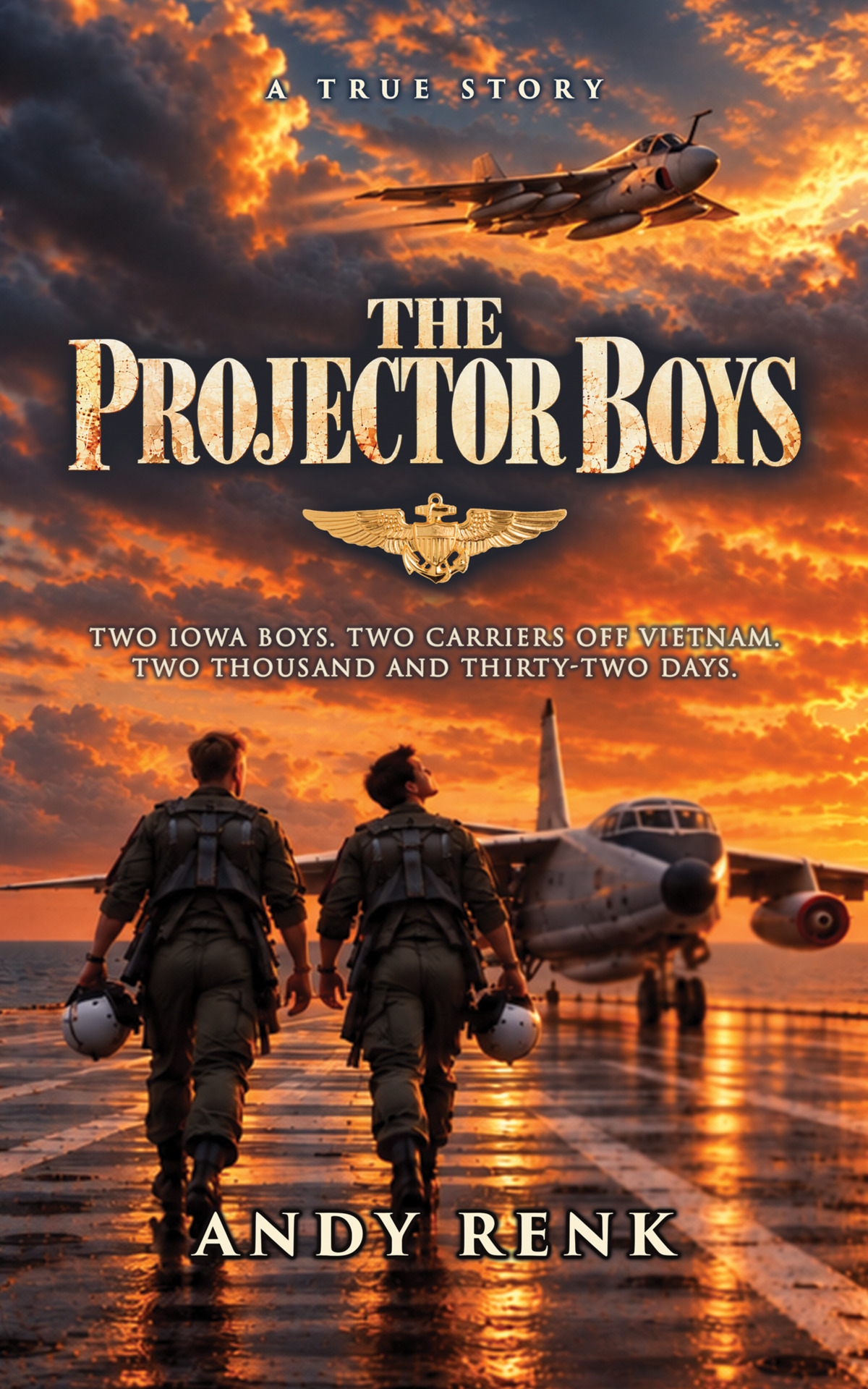
- Book cover for web useJPEG · 1200 × 1920 px.
- Supplied Kindle cover sourcePNG · 1600 × 2560 px · print readiness and 300 dpi are not confirmed.
Photographs
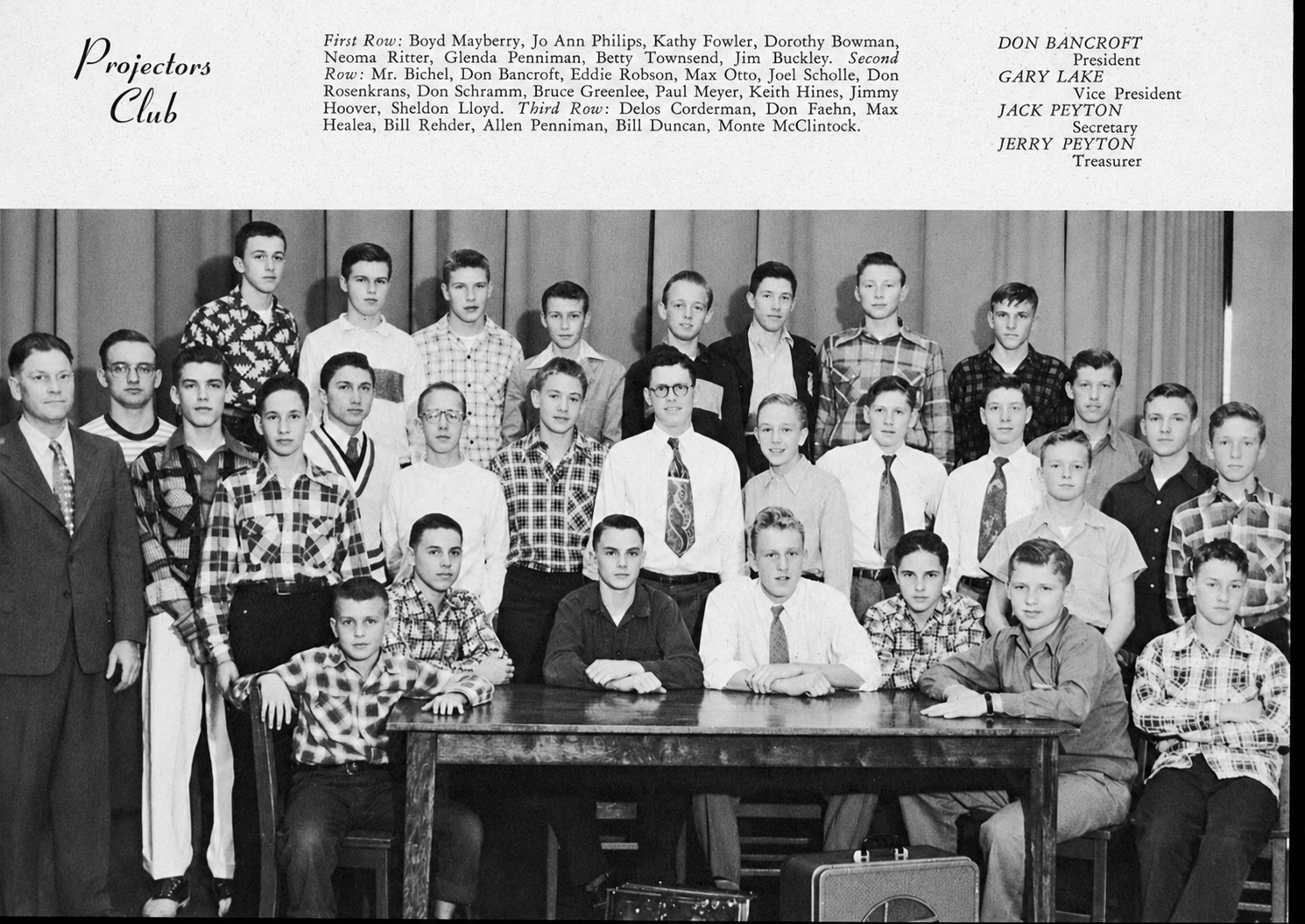
The Projectors Club at Sac City High
The Projectors Club of Sac City High. Max Otto is seated second from the right at the table; Jimmy Buckley is seated third from the left, in the dark shirt. “The famous ‘class skippers’ of old S. C. High.”
The Chieftain, 1951.
Download full image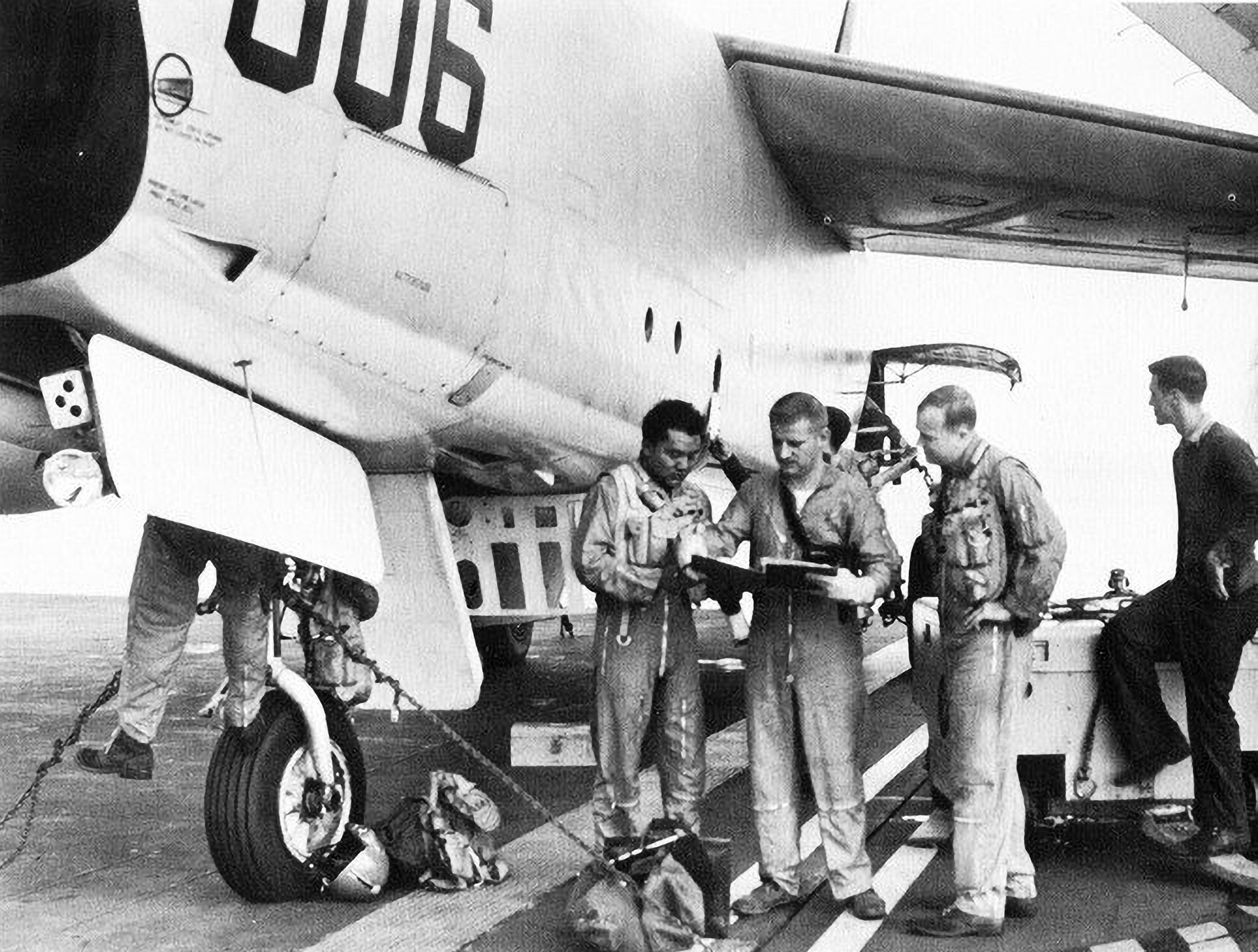
Max Otto on USS Kitty Hawk, 1961
Max Otto with the manual on USS Kitty Hawk’s flight deck during the voyage around South America, 1961. The crew’s own caption reads: “It doesn’t say anything about how to get him out!”
USS Kitty Hawk cruise book, 1961.
Download full image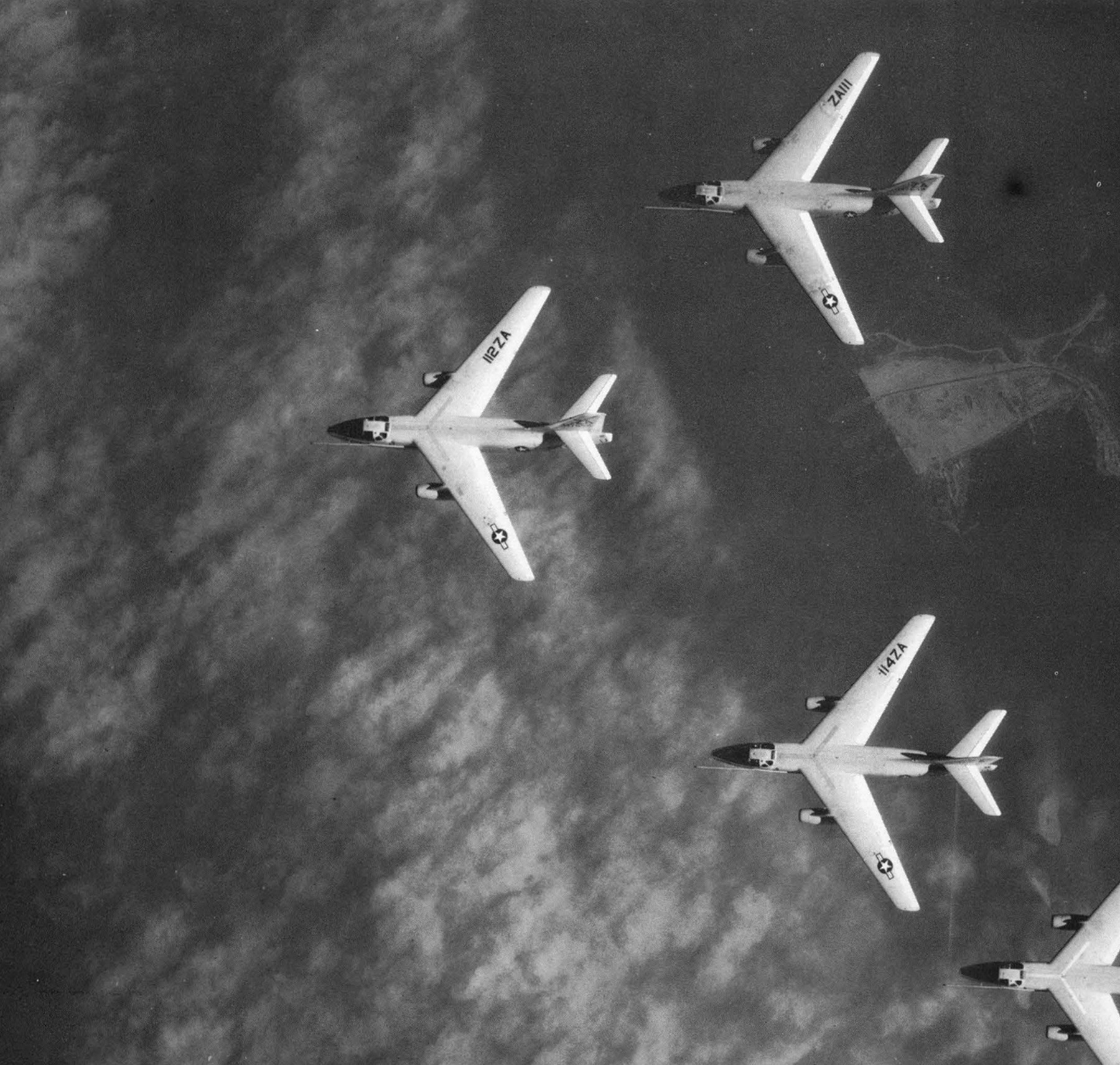
A-3B Skywarriors of Heavy Attack Squadron Two
Four A-3B Skywarriors of Heavy Attack Squadron Two in echelon — tail codes ZA 111, 112 and 114. Seventy thousand pounds apiece, and no ejection seats in any of them.
USS Enterprise cruise book, 1966–67.
Download full image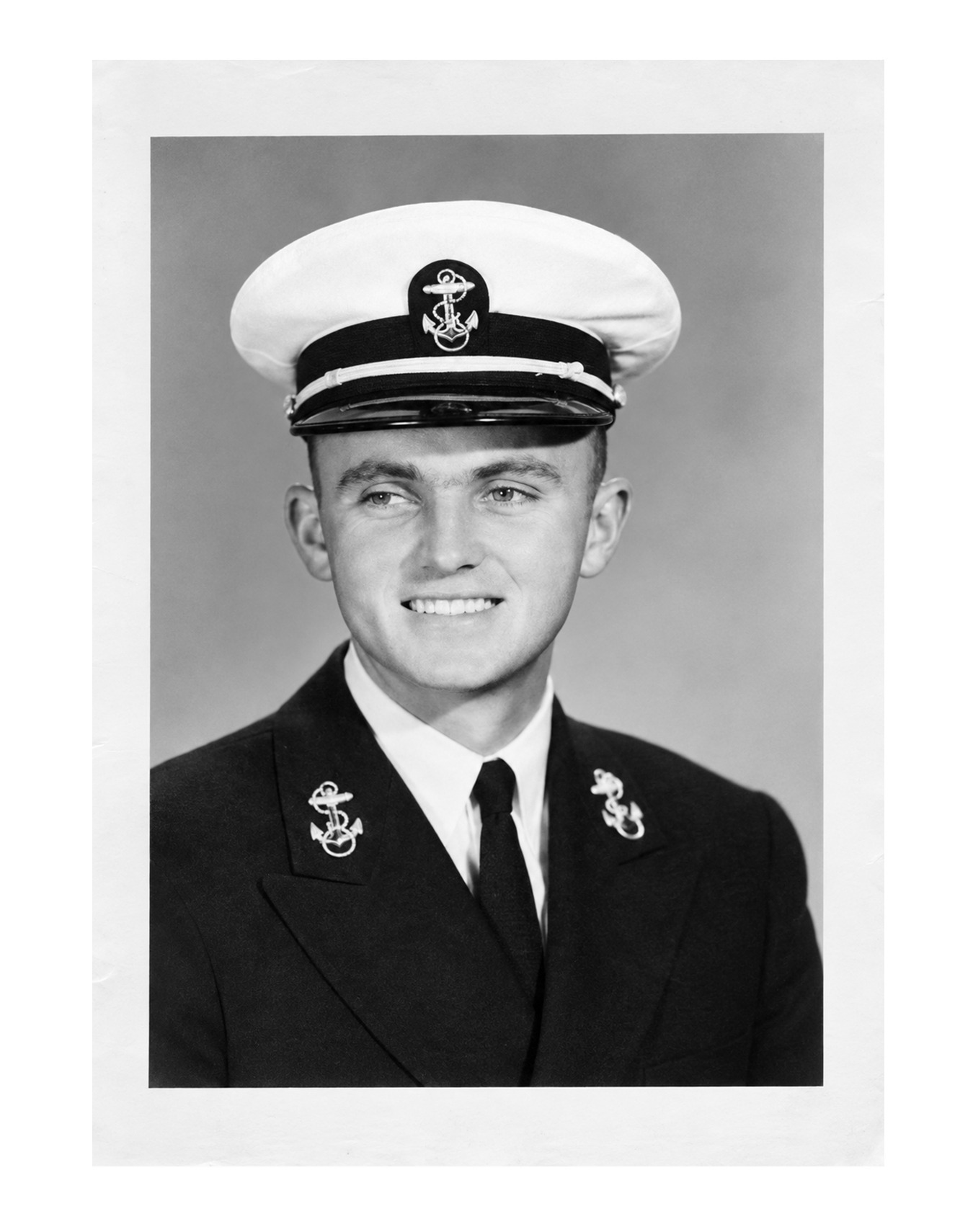
Jimmy Buckley in service dress
Jimmy Buckley in service dress as a Naval Aviation Cadet.
The supplied photo archive did not include an original-source credit.
Download full imageAudio sample
Listen: Chapter One, “All Boy” — opening, 3:57
Interview questions
- Walter Otto’s photographs and home movie started the research. What did that first material reveal, and what did it force you to find elsewhere?
- You worked from letters, squadron records, newspapers, and family memories. When they disagreed, how did you decide what the evidence could support—and what had to remain uncertain?
- Max Otto and Jimmy Buckley began as classmates running the projectors at Sac City High. How did you keep that ordinary beginning present while telling a story shaped by war?
- On August 21, 1967, Robert Flynn was the only living witness to what happened to the other airplane. What can the surviving records reconstruct, and where do they stop?
- Flynn spent 2,032 days in solitary confinement. How did you write about that span without letting the number stand in for his experience?
- Jimmy Buckley’s remains were identified by mitochondrial DNA decades later. What did that identification answer, and what questions did it leave open?
- You wore Max’s flight suit as a boy and later worked on the C-17 and the F/A-18 arresting hook. How did your personal and engineering perspective deepen your understanding, and what assumptions did you have to set aside?
- The book includes 46 photographs in a 48-page section. How did you decide which images belonged, and what could they tell readers that the written record could not?
Contact
Interview and review requests: andy@theprojectorboys.com
602-828-4498