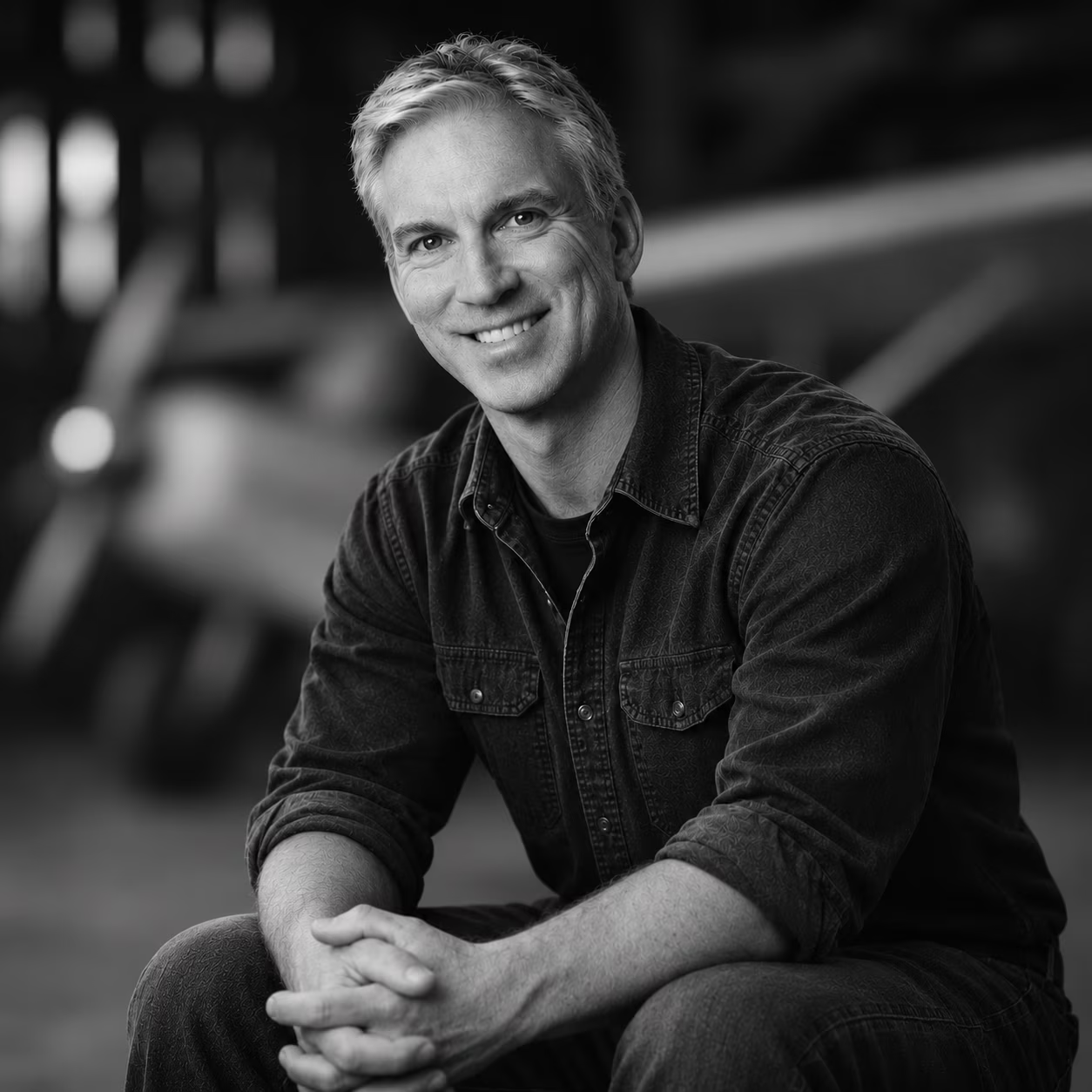
About the author
Andy Renk
Andy Renk is the nephew of Max Otto, one of the two Navy aviators at the center of The Projector Boys. In the mid-1970s, in Sac City, Iowa, he tried on his uncle's Navy flight suit — helmet included, with the bat of Fleet Air Reconnaissance Squadron One on the side. Max was alive then.
Renk studied engineering at Iowa State and went to McDonnell Douglas as an industrial engineer, working out the manufacturing processes for Ship 1, the first C-17 Globemaster III built, and for the F/A-18's arresting hook, down to the welding. He was there when Ship 1 flew. The hook is the part that stops the airplane and the welds are the part that cannot fail. His uncle caught a wire with one on every landing of his career.
The Projector Boys took three years. It is built from the men's own letters, their squadron records, newspaper archives, and the memories of the people who knew them. Renk is a student pilot and lives in Arizona with his wife, Sophia.
From the book
Author's Note
Winona, Minnesota, had an airplane in a park.
The city set a Grumman F9F Panther down beside Lake Winona for children to climb on, and in those years there was no fence around it. I was eleven or twelve. We were all over that airplane — the wings, the fuselage, every part of it a boy could get a foot on. Somebody eventually pried the sheet metal off the cockpit windows, and after that we could sit where the pilot had sat. You could get into the engine bay too, if you were small enough, and I was.
The Panther was Grumman's first carrier jet. The engine that had once filled the space I was sitting in took that airplane off a flight deck and brought it back.
I did not know that at the time. I knew it was an airplane and that it was ours.
A year or two later, in Sac City, Iowa, my uncle's flight suit was in the house. Max Otto flew for the Navy — Skywarriors, off carriers — and we were told we could try it on. It came with the helmet, and the helmet carried a bat: the mark of Fleet Air Reconnaissance Squadron One. I put the whole thing on. I was twelve or thirteen. It did not fit, and I wore it anyway for as long as they let me.
Max was alive then.
Years after that I went to work at McDonnell Douglas as an industrial engineer. My job was manufacturing processes — not what a part should be, but how it actually gets made, down to the welding. I worked on Ship 1, the first C-17 Globemaster III ever built, and I was there the day it flew. I also worked the manufacturing side of the arresting hook for the F/A-18.
The hook is the part that stops the airplane. The welds are the part that cannot fail.
My uncle caught a wire on every landing he ever made.
This book began with an email. Walter Otto, Max's son, sent my mother — Max's younger sister — a batch of photographs of his father in the Navy, along with a home movie nobody had seen in decades. I started reading. Three years later, this is what I had.